
Web Scraping Services: What Companies Should Collect
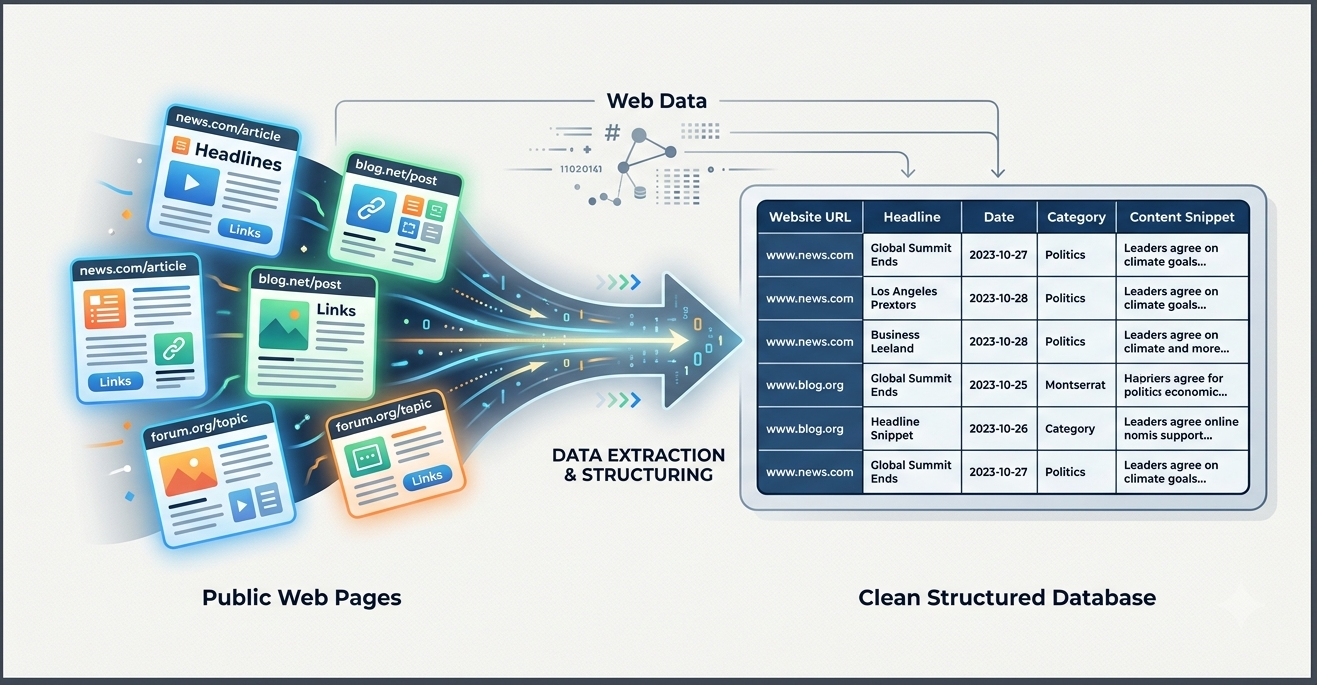
Someone on the team opens the same websites every morning, copies prices, listings, or public records, and pastes them into a sheet. It works until the page moves, the person is out, or the list grows from ten sources to a hundred.
That is the job web scraping services take on. They collect public website data on a schedule, check that the result is still usable, and put it where reporting and operations can use it.
This guide is for a company that already knows the sites it cares about, and wants that collection to run without a person sitting in the middle.
What Do Web Scraping Services Actually Do?
They turn public pages into a dataset you can query.
A page is built for a person to read. A warehouse, a database, or a report is built for a team to reuse. Web scraping services sit between those two.
A useful service does four things:
- Visits the public pages you name, on a schedule you set
- Pulls the fields you care about, such as price, title, date, or location
- Writes those fields into a table, a file, or a warehouse
- Tells you when a page layout changes and the pull fails
The output should look boring. One row per item. The same columns every run. A timestamp for when the row was collected. If the file needs a person to clean it before anyone can use it, the service stopped too early.
Rowbeam's web scraping service is built around that outcome: scheduled collection, structured output, and a log when a source page moves.
When Does Copying by Hand Stop Working?
It stops when the list of sources, or the cost of a missed update, gets bigger than one person's morning.
Hand collection is fine for a one-off check. It breaks in ordinary ways:
- The same page is copied twice, or skipped
- A column shifts and last month's numbers no longer match this month's
- A site redesigns, and nobody notices for a week
- The only person who knows the steps is on leave
Teams usually feel this first in pricing, supplier catalogs, public tenders, job boards, or any list that changes on someone else's website. The business question is simple. Do we need this data every day, and can we afford a silent gap?
If the answer is yes, a scheduled collect is cheaper than a standing task on someone's calendar.
What Should a Web Scraping Service Include?
A schedule, a stable output, and a way to see when a source breaks.
Ask for these pieces before you buy or build:
1. A named list of sources
Write down the sites, the page types, and the fields. "Competitor prices" is not a spec. "These 40 product URLs, the current price, the currency, and the stock line" is a spec. Vague scope is how a project collects the wrong thing, very reliably.
2. A schedule that matches the decision
Prices used in a daily quote can run overnight. A catalog that changes monthly does not need a pull every hour. Faster is not better if nobody acts on the extra runs. Agree the cadence up front.
3. Checks when the page changes
Sites redesign. A button moves. A table becomes a card. A service that only fails in silence will look healthy while the table goes stale. You want a retry, a log, and a note when the layout no longer matches the fields you asked for.
4. Output your systems can read
The result should land in a database, a warehouse, or a file with fixed columns. From there it can feed a data pipeline and show up in the same reports as the rest of the business. A spreadsheet attachment sent to one inbox is a temporary bridge, not the destination.
5. Limits that respect the site
Collection should be paced. Public pages are still someone else's property and someone else's servers. A careful service uses rate limits, collects only what you specified, and does not hammer a site because a schedule was set too tight.
What Should You Leave Alone?
Private data, login-only pages, and anything the site does not make public.
Web scraping services are for public pages. They are not a way to pull customer records, personal data, or content that sits behind a login you do not have a right to use.
Before a source is added, check three things:
- The page is public, without an account
- You need the facts on the page, not a copy of the site's design or full text for republishing
- The site's access rules do not forbid the collection you have in mind
If a source fails those checks, leave it out. A shorter list you can stand behind is better than a wide one that creates a legal or reputational problem. If you are unsure, ask before the first run, not after the data is already in a report.
How Should the Data Fit the Rest of the Business?
The scrape is a source. The pipeline is what makes it trustworthy.
A collected table still needs the same care as any other feed:
- The same product, supplier, or listing should not appear as three different names
- Old rows should stay, with the date they were seen, so you can see change over time
- A failed run should be visible, so a report does not quietly reuse last week's file
- The fields should match the definitions finance and operations already use
That is ordinary data engineering. The scrape gets the raw public facts in the door. Cleaning, history, and delivery into a report are the next step. Companies that skip that step end up with another folder of files and the same argument about which number is right.
How Do You Choose Web Scraping Services?
Choose the one that can show you the output, the failures, and the limits.
A demo that pulls one page in a meeting is not the service. The service is what happens on a Tuesday when that page has changed.
Use a short test:
- Pick five real URLs, not a sample the vendor chose.
- Name the fields, the schedule, and where the rows should land.
- Ask what you will see when a page returns nothing.
- Ask how often the layout has to be fixed, and who does that fix.
- Confirm the run stays within the site's access rules.
Price matters, but a cheap run that you cannot audit will cost more the first time a report is wrong. You want a record of what was collected, when, and from which page.
What You Should Have at the End
A table the team trusts, updated without a person copying the page.
Web scraping services are worth it when three things are true. The pages are public. The fields are specific. Someone makes a decision with the result on a regular schedule.
If those are true, stop treating collection as a task. Treat it as a feed: scheduled, checked, and stored with the rest of your data.
If you want that feed built and looked after, start with the sources and the fields. Rowbeam can collect the public pages, land them in a database, and connect them to the pipelines and reports you already use.
Contact: contact@rowbeam.com